Blog

Google Updates Its Knowledge Graph Cards By Adding Tabs In Mobile Search

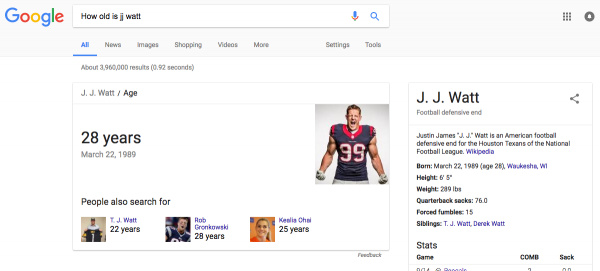
Google is upgrading their Knowledge Graph cards by adding more tabs for certain searches in mobile search. This change will first impact movie updates and later will impact both movies and books.

For those who don’t know what the Knowledge Graph is exactly, it is technology that was launched back in 2012 as a way to give additional information to the user regarding their search query, directly on the search result pages.

The Knowledge Graph was designed to give users popular facts about people, places and things in addition to Google’s traditional results. The Knowledge Graph technology enabled Google to move towards a new type of search result. Now, their new way of searching could not only result in links but could match search terms to related concepts.

Google Updates Its Knowledge Graph Cards By Adding Tabs In Mobile Search

The latest updates to Knowledge Graph cards are for movies. They allow the user to better understand the title they are interested in learning about.

The new tabs include the original tabs plus the following additions: Search, Top Stories, Trailers & Clips, and Similar Movies.

A user can now simply scroll down to the Knowledge Graph card information and will experience the tabs snapping to the screen.

While news of the tabs was exciting, many questions remained regarding the specifics of the change. While Google’s tweet made it seem like the update was now effective, that was apparently not the case as some people could not see the update.

Other questions focused on which other categories would eventually be affected by these updates. As the initial mention focuses on movies, books, and stock cards, users wondered if other categories will ever see these same changes.

Another big concern surrounds the potential impact on website traffic. Now that Google is making it easier to find the answer to a question without going to another website, will some affected websites experience decreased traffic?

The answer to this question is somewhat known: the Knowledge Graph does impact traffic (it decreased Wikipedia’s traffic by 21%). However, business owners can’t really impact if their information is being used by Google in these graphs. Businesses should recognize that by Google “scraping” their information, they are really just getting another vote of confidence in regards to their quality content.

For more answers regarding the future of Knowledge Graphs, SEOs and marketers will just have to wait and see what happens.

Looking to better understand how this update will impact your brand? Reach out to Hall Analysis today.

screenshot was taken September 2017

Google Says They Don’t Rank Large Sites Better

John Mueller of Google shared recently that there is no correlation between the size of a site and their rankings.

According to his tweet from September 6th, he responded to a tweet by saying that there was no designed correlation between site size and rankings.

This comment shared information relevant to the findings from a poll created by Search Engine Roundtable back in 2013. The poll had close to 400 responses, which revealed what SEOs really thought about the potential correlation between site size and rankings.

The poll unveiled that 57 percent of SEOs felt that bigger sites did, in fact, rank better in Google search results. Only 9 percent of respondents thought that smaller sites ranked higher and 34 percent said that site size had no impact on rankings.

Google Says They Don’t Rank Large Sites Better

While Mueller’s tweet dispelled the rumors surrounding the topic, Google remains devoted to their prioritization of quality content. Meaning that the more quality content a website has, the better that site’s rankings will be.

This means that although large sites don’t necessarily receive higher rankings simply based on their size, a large site with high-quality content could receive a higher ranking than a smaller site with high-quality content. This happens because the more pages you have, the more opportunities you have to write useful, topical content, which can get you noticed in rankings. However, if those pages are poorly built and are “spammy” in nature, Google could ignore the information.

In addition, John Mueller had also recently addressed the idea of creating “spammy” content in a tweet from August. When asked about a limit on the number of website pages, Mueller warned against creating a high number of pages. He went on to explain that big sites can have many pages and as long as the content is unique and high-quality, it’s not an issue. However, if a website has simply created millions of pages with low-quality content, it could register as spam.

Wondering how this news affects your business? Are you unsure if your site contains what Google would deem to be quality content? Reach out to Hall Analysis today to learn how to make your website more effective.

Photo via Pexels

Study Shows That 57% Of Search Traffic is Now From Mobile

According to a new study from BrightEdge, 57% of all search traffic is coming from both smartphones and tablets. This change goes along with Google’s decision to move to a mobile-first index, giving mobile friendly sites an advantage at being indexed first.

Study Shows That 57% Of Search Traffic is Now From Mobile

The report also revealed a large disparity between ranking positions depending on if the search was from a mobile or desktop device, which impacted the vast majority of keywords. BrightEdge’s research study showed that 79% of keywords ranked differently on a desktop search versus a mobile search. Of the 79% involved in the disparity, 47 percent were keywords in the top 20 positions.

This revealed that site owners are missing out on opportunities when it comes to views on their most important pages.

The study explained the opportunity for change by highlighting an example of a certain website. This website ranked differently 35% of the time when comparing desktop to mobile, even when it was most likely to be in the number one spot.

BrightEdge recommended that brands begin tracking of their search results for both mobile and desktop channels. Once tracking and analyzing the results, brands will have a better understanding of their current situation and can then adjust their strategy.

The study also recommended that brands understand which of their device channels was more important for different keywords. The device channel that is more powerful for a given keyword should be prioritized and optimized to take advantage of a potential opportunity. Only after that should the second channel be optimized. The keywords a brand ranks for is may vary by channel, but due to Google’s move toward a mobile-first index, brands should be focusing on mobile first.

To see the BrightEdge report in its entirely, the full download is here.

Want to learn how much of your search traffic comes from your desktop versus mobile devices? Hall Analysis can help you prepare your websites so that they are ready for the change in search preferences.

Google’s Voice Search Is Now Available To Over One Billion People Worldwide

According to Search Engine Journal, Google’s voice search is now available to over one billion people worldwide.

Thanks to this new language rollout, Google has now added 30 new languages to their speech recognition software, bring their total number of languages to 119. This software also has the ability to support the emoji language.

The new emoji language addition allows users to use their voice to dictate in US English to translate phrases into emojis. For example, users can now state “smiling face with open mouth” and receive the matching emoji imagery.

The addition of these new languages is part of Google’s attempt to increase communication worldwide by honoring more languages. This new update includes a variety of languages, including the Georgian language which is from as far back at the 10th century.

Google shared that they were adding specific languages like Swahili, Amharic, and multiple Indian languages in their quest to make the online world more inclusive.

Google shared that they did work with native speakers of each language so that the internet giant could gather speech samples for these new additions. One way that they gathered this intelligence was by requesting that the native language speakers say common phrases. The purpose of this technique was to train the software to understand the intricacies of the spoken language. The machine was then tasked to focus on sounds and words, which over time allowed for improved accuracy.

Not only will these languages be included in voice search, but they will also become available to those using the Cloud Speech API. These languages will also be added to a variety of other Google products.

Looking to learn how these new languages will affect your business? Hall Analysis would be happy to help you prepare for these language updates.

10 Common SEO Mistakes Made When Switching To HTTPS

Unfortunately, over the years I have found more SEO risk switching to HTTPS, than the claimed SEO value. In fact, I oftentimes feel that switching to HTTPS provides such a large risk for SEO, that in many cases it’s not warranted or even desired to do such a change. However, now Google is applying more and more pressure on webmasters to implement secure URLs. And admittedly HTTPS is the right choice for protecting your users.

Most of the SEO risk associated with switching to HTTPS is a result of mistakes made during the redirection process. This is true for changing any URL structure, however, special hurdles are often presented when changing at the protocol level. Below are 10 common mistakes I’ve seen over the years of helping clients make this change and fixing their mistakes. You should be mindful of all of the below possible issues. As well as thoroughly test your implementation prior to launch.

Using a 302 redirection

A 302 redirection means a temporary redirection. Where a 301 means a permanent redirection. When redirecting a URL it’s important to use a 301, otherwise Google and other search engines may not follow or apply the same signals to the new URLs. This is a common mistake made by people that do not practice SEO. However it is also extremely easy to make this mistake if you are an experienced SEO. This is because the htaccess directives and other server functions are extremely similar to each other. I myself have made this mistake before after doing SEO for about 8 years. Always double-check your htaccess redirection rules to make sure you’re applying the right redirections.

Not updating legacy redirects

Let’s say that when your site first launched, your URL structure included “www”. However maybe a year later you may have decided to remove the “www”. To do so you may have used a 301 redirect to the non-www state. Now you’ve decided to switch to https and you setup redirects to the HTTPS version. If you fail to update the original redirects away from the”www” version, then you have inadvertently created a redirect chain from the URL structure that the site was originally launched with. This means any inbound links that were acquired within the first year site was launched are likely losing significant link equity because those links have to pass through a second redirect to get to the HTTPS version.

Because of this, legacy redirects generated prior to the HTTPS switch should be updated from the original URL structure directly to the new HTTPS version. Failure to do this may result in significant backlink equity loss.

I once found a client that lost about 80% of its back link profile because of this scenario.

Not updating canonical tags

Canonical tags are vital to communicate to Google the preferred structure and protocol of the page. If HTTPS is not included in the canonical tags, it may send mixed signals to Google’s crawlers as to which URL standard should be applied.

Failure to update internal links

Many SEOs and web developers assume that if redirections are in place they do not need to update internal links that point to the new HTTPS urls. This is problematic because most modern web browsers will detect that there are links on the page to unsecured pages on the same domain and may provide an error when visiting the page. Failure to update internal links also creates sitewide redirections on all URLs that the crawler hits on each page. Despite the fact that Google claims that 301 redirections do not affect link equity, it’s likely that if there are 1000s of links that are not updated at scale will affect not only the loss of link equity but exacerbate and maybe deplete Google’s crawl budget for the domain, because of the extra work of processing the redirects. All internal links should point directly at the HTTPS version of the site.

Not anticipating how your SSL provider deploys

In some instances an SSL certificate provider may implement redirections without consulting their customers. I have seen this happen twice before and it causes major issues if a web developer has already set up their own server side redirects. This typically occurs if you purchase your SSL certificate from your DNS provider. Therefore, you should touch base with your SSL provider to make sure you fully understand how they deploy, and if there are any built-in redirections already in place. Otherwise, you may be at risk of creating a redirection loop or possibly timing out the server. This is critical.

Conflicts with CMS

Some Content Management Systems also deploy automatic redirection after changing the internal URLs. If you do not anticipate this happening and you have already generated your own redirections on the server it can again create redirection loops or possibly server timeouts. Testing your content management system prior to changing your URL structure is smart.

Failure to update CDNs

Many high traffic sites utilize Content Delivery Networks to host images and other third-party resources. These URLs must be updated to HTTPS versions in order to maintain a secure browsing experience as well as to provide the correct signals to Google and any Canonical URLs. This is especially important for CDNs that use a subdomain mask like cdn.example.com

Failing to update vital 3rd party resources. (like XML site maps)

In some cases a site (especially e-commerce sites) may choose to house their XML sitemap on a third-party server. I personally advise against this behavior, however if a website chooses to go this route they should make sure that their XML sitemap is updated with fresh URLs as well as the direct URL path to the site map itself.

Not adhering to existing canonical URLs within redirects.

If a canonical URL structure is in place prior to implementing HTTPS, that same structure should be applied during the redirection. This means not accidentally adding a forward slash “/” or removing a file extension at the end of certain URLs.

Only securing part of the site.

In several cases I have seen domains implement only a section of the site for HTTPS such as the shopping cart or contact forms. While this may seem like a fair middle ground, it can actually create more problems by confusing the crawler and inadvertently breaking canonical URL structures. If you are switching to HTTPS, you should do it “domain wide” and not isolated to one section of the site.

Conclusion: Plan and test everything.

I can’t stress this enough. Every process during the implementation of HTTPS URLs needs to be planned and tested thoroughly before deploying. This includes understanding every element of the process and testing each before launch day. The vast majority of issues arise when webmasters take a cavalier attitude to making such a significant change.

If you have more questions or would like a completely custom strategy for your site implementation please get in touch with us as soon as possible. We have experience planning and implementing these types of changes for a diverse array of different types of websites.

[image credit]